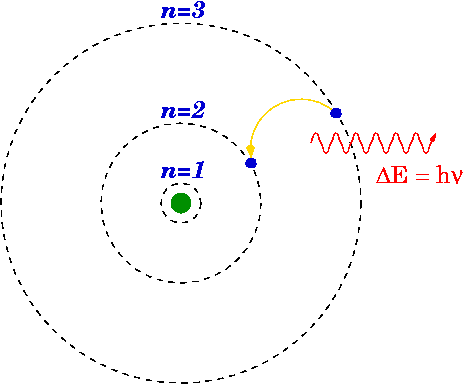
Atoms look like tiny solar systems, with electrons orbiting the nucleus in fixed circular paths.
Electrons occupy probabilistic orbitals, not fixed circular paths. The quantum mechanical model had superseded the Bohr model by the late 1920s but textbook diagrams lagged far behind.
What changed?
Niels Bohr proposed his atomic model in 1913 and it was an immediate triumph. Before Bohr, physicists knew atoms had a dense positive nucleus (Rutherford had established that in 1911) and electrons somewhere around it, but had no explanation for why electrons didn't simply spiral into the nucleus, radiating energy as they went. Bohr solved it with a bold postulate: electrons can only occupy certain fixed orbits, and they don't radiate energy while staying in one. The model predicted hydrogen's spectral lines with stunning precision. The solar system analogy was irresistible, a central nucleus like the Sun, electrons wheeling around it like planets, and the image stuck.
The problem arrived quickly. The Bohr model worked beautifully for hydrogen, with one electron. For atoms with more than one electron, it failed. More fundamentally, it offered no explanation for why only certain orbits were allowed. Bohr had imposed the rule without deriving it.
The explanation came in the mid-1920s in a rush of new physics. Louis de Broglie proposed in 1924 that electrons have wave properties. Werner Heisenberg formulated his uncertainty principle in 1927: the more precisely you know an electron's position, the less precisely you can know its momentum, and vice versa. You cannot, even in principle, specify a fixed circular path. Erwin Schrödinger's wave equation, published in 1926, replaced the tidy orbits with probability distributions, mathematical regions of space where an electron is likely to be found. These regions are called orbitals, not orbits, and they look nothing like planetary paths. Some are spherical, some are dumbbell-shaped, some have complex lobed geometries.
The quantum mechanical model of the atom became the established framework of physics and chemistry by the late 1920s. Yet the solar system diagram, neat circles around a dotted nucleus, continued appearing in American science textbooks through the 1970s and, in some cases, well beyond. It persists today in logos, icons, and popular imagery. It's wrong as a literal description of atomic structure, but it retains a powerful hold because it's the only atomic image simple enough to draw.
What electrons actually do is stranger than orbits. Each electron occupies a standing wave pattern that envelops the entire nucleus. It doesn't travel a path; it exists as a smeared probability until measured. The Bohr model was a crucial step, a bridge between classical physics and quantum mechanics, but the bridge is not the destination.