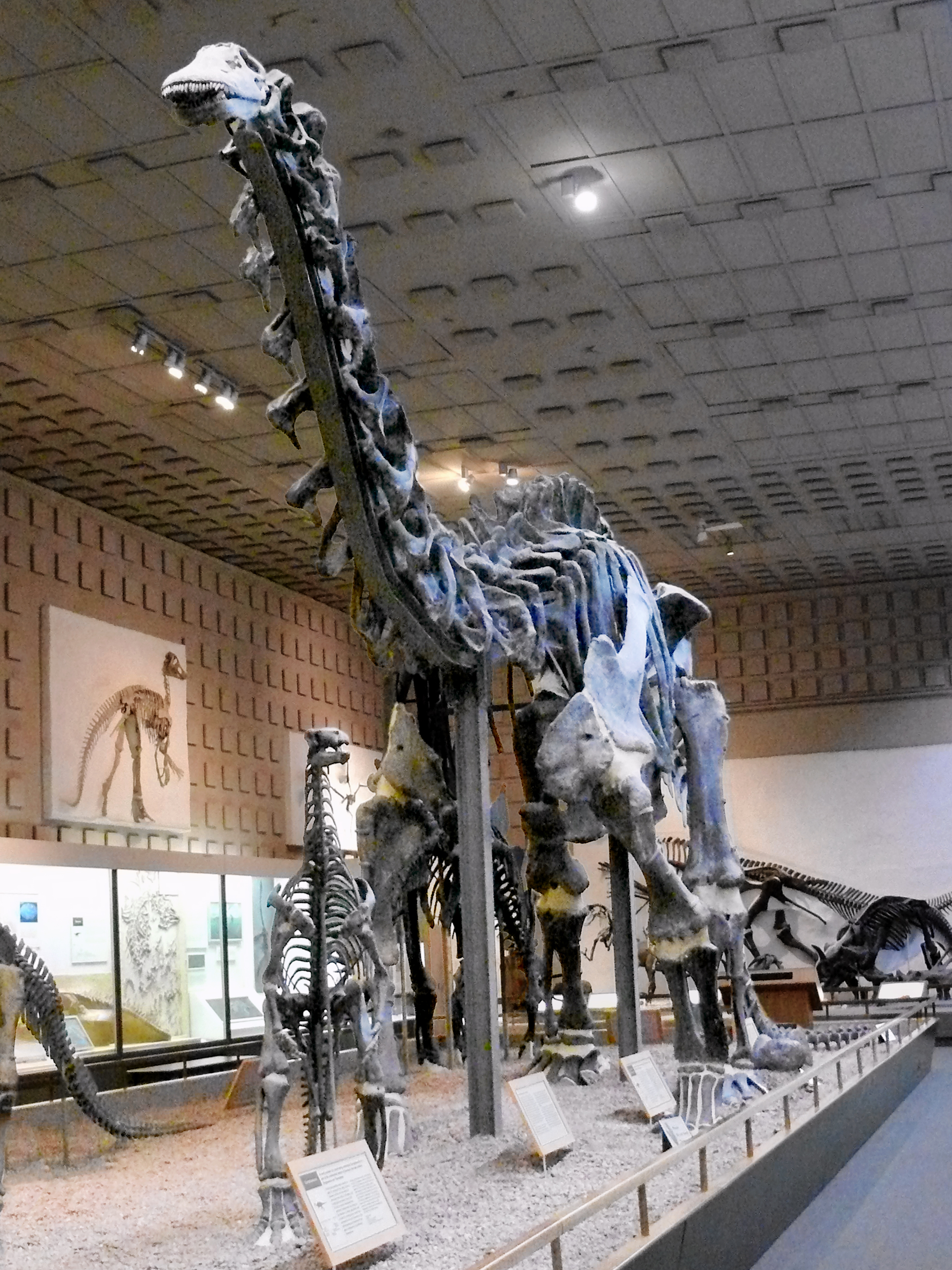
Brontosaurus was reclassified as Apatosaurus and is not a real genus.
A 2015 study suggested Brontosaurus may be distinct enough to be its own genus after all, though this remains debated.
What changed?
Sometime in the late 1970s and early 1980s, natural history museums across North America began relabeling their sauropod mounts. The famous long-necked dinosaur that generations had called Brontosaurus, mounted at the American Museum of Natural History since 1905, adopted by Sinclair Oil as a corporate mascot, a fixture of children's encyclopedias, acquired a new official name: Apatosaurus. The scientific correction had been published in 1903 by Elmer Riggs, who showed that Marsh's two genera were actually one. The older name, Apatosaurus, held priority under the rules of nomenclature. Brontosaurus was a junior synonym, technically invalid. The field had finally caught up with itself, and the story seemed closed.
For over a century, the reclassification was accepted without serious challenge. Each generation of researchers inherited the synonymy from the previous one. It appeared in textbooks, reference works, and popular science writing. The belief that Brontosaurus was not a real dinosaur, that it had been a case of Bone Wars double-naming corrected at the dawn of the twentieth century, became standard knowledge in the scientific literature and popular science alike. Museum visitors who asked about the name change were told that science had simply fixed an error. The correction was treated as settled in a way that few taxonomic decisions ever are.
Emanuel Tschopp was not trying to resurrect the name when he began his doctoral research at the Universidade Nova de Lisboa. He was conducting a comprehensive phylogenetic analysis of diplodocid sauropods, supervised by Octávio Mateus. His methodology departed from standard practice. Rather than grouping specimens under prior genus names and then comparing the groups, Tschopp treated each individual specimen as a separate data point, 81 specimens coded for 477 morphological characters drawn from 49 localities across North America and Europe. The dataset was the most extensive treatment of the diplodocid family tree ever assembled.
Working with Roger Benson of the University of Oxford, who contributed an independent pairwise dissimilarity analysis during peer review, Tschopp processed the character matrix and allowed the evolutionary relationships to emerge from the data without pre-assigned taxonomic labels. The specimens traditionally classified as Brontosaurus consistently formed a cluster distinct from those of Apatosaurus, with morphological differences visible in the cervical vertebrae, the humerus, and the proportions of the ilium. The distance between the clusters was comparable to the distances separating other diplodocid genera, Diplodocus from Barosaurus, for instance, that no researcher disputed. Published in PeerJ in April 2015, the paper formally proposed reinstating Brontosaurus as a valid genus.
Responses in the field were divided. Several prominent diplodocid specialists questioned whether the specimen-level approach might conflate individual variation with taxonomic signal, and whether the character coding had been structured in a way that favored splitting. The debate continued in subsequent publications without reaching consensus. Reinstating a long-accepted synonymy is uncommon in paleontology: the rules of nomenclature strongly favor the established name, and overturning a correction made over a century earlier requires substantial evidence. The controversy reflected genuine methodological disagreement, not simply resistance to a surprising result.
What the episode revealed, regardless of its ultimate taxonomic resolution, was that the century-old consensus had rested on thinner foundations than the literature implied. Riggs's 1903 synonymy was accepted and repeated but never subjected to a large-scale quantitative review. Tschopp's study was the first comprehensive phylogenetic analysis of diplodocids built with modern tools, and its finding, however contested, showed that the question had not been as settled as anyone assumed. Science, in this instance, had not overturned a correction so much as examined it more carefully than it had ever been examined before and returned a qualified, uncertain verdict. Whether Brontosaurus and Apatosaurus eventually resolve as one genus or two, the case is a rare instance in which careful revisitation found genuine uncertainty where confident correction had long been taken for granted.