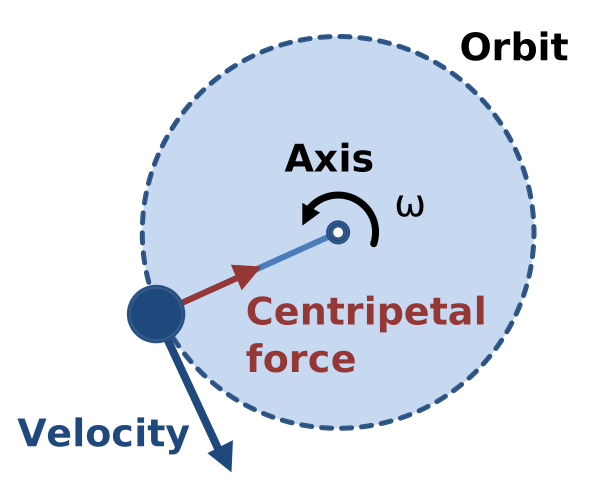
Centrifugal force is a real outward force that pushes objects away from the center of rotation.
Centrifugal force is a fictitious (inertial) force - it only appears in rotating reference frames. The real force is centripetal, pulling inward.
What changed?
The feeling is unmistakable. You're in a car rounding a curve and you feel pushed hard against the door. A bucket of water swung on a rope holds its contents against the bottom, as if some force is pinning the water down. A clothes dryer pushes laundry against the drum wall. Something is clearly acting outward. We call it centrifugal force, and it seems as real as any force you've ever felt.
Newton would disagree. In his framework, the framework of all classical mechanics, forces have sources. Gravity comes from mass, electromagnetic force from charge, friction from contact. Centrifugal force has no source. In an inertial (non-accelerating) reference frame, there is no outward force on the car passenger. What there is, instead, is a car door pressing inward, providing the centripetal force that keeps you turning with the car. Your body wants to continue in a straight line, that's inertia, and the door won't let it. You feel the door push you; you interpret it as being pushed outward.
The distinction matters because it depends entirely on where you're doing your physics. In an inertial reference frame, one that isn't accelerating or rotating, centrifugal force does not appear. The only real force is the centripetal one, always pointing toward the centre of the circular path. For a planet orbiting a star, that's gravity. For a ball on a string, it's tension. For a car turning, it's friction between the tyres and the road.
In a rotating reference frame, say, you're sitting inside the rotating drum of a centrifuge, trying to do physics as if you were stationary, centrifugal force does appear, as a mathematical term that must be added to Newton's equations to make them work in that frame. Physicists call this a "fictitious force" or "pseudo-force": not something that acts on objects from outside, but a correction term that accounts for the fact that your reference frame is accelerating. The Coriolis force, responsible for the rotation of hurricanes, is another fictitious force in the same sense.
Engineers routinely use centrifugal force as a working concept and it produces perfectly correct results in rotating frames. The confusion arises when it's presented as a real physical force in the same category as gravity or friction, rather than as a frame-dependent mathematical convenience. You are never actually pushed outward. You are simply allowed, or not allowed, to continue in a straight line.