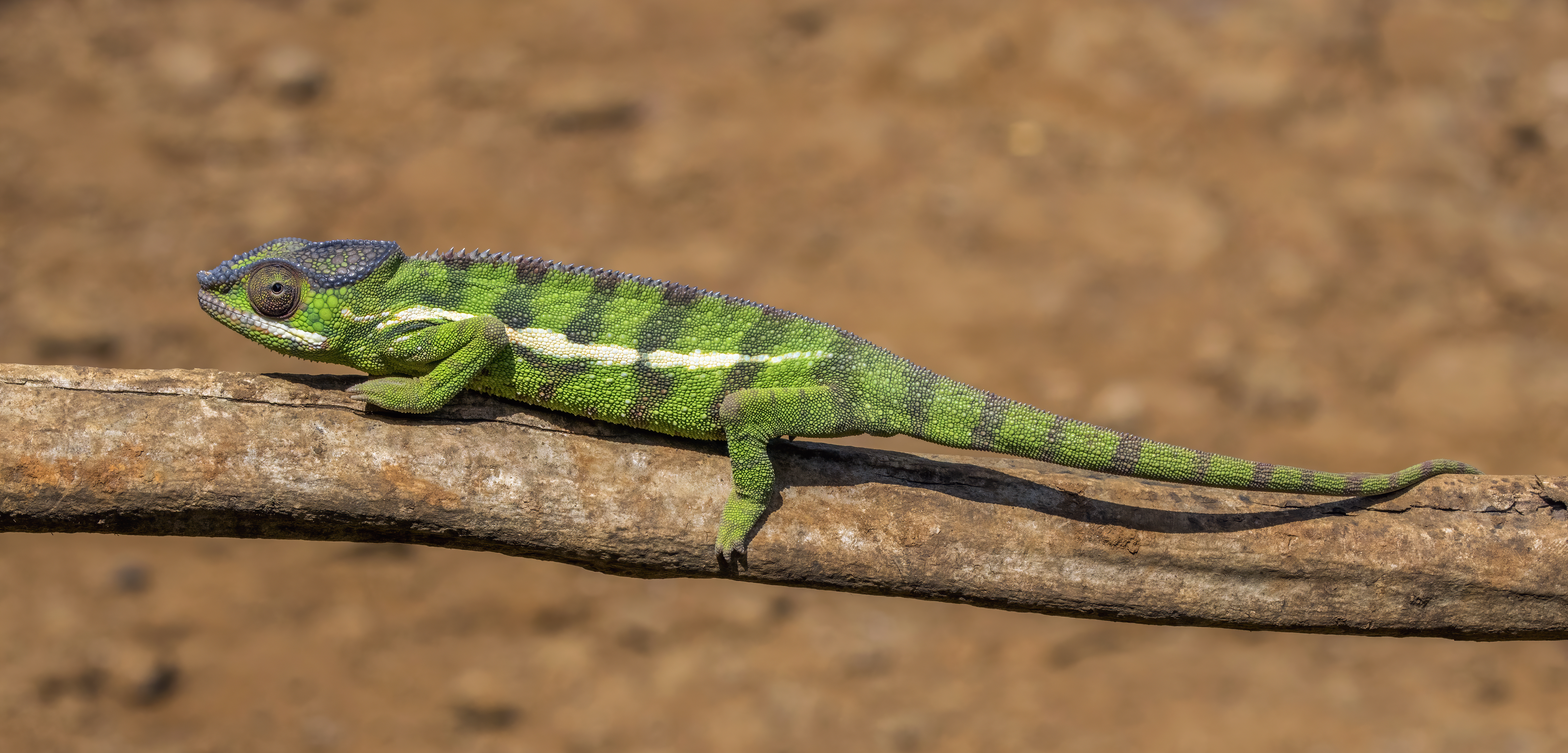
Chameleons change color primarily to blend in with their surroundings and hide from predators.
Chameleons change color mainly for communication (mood, temperature, mating signals) and social interaction. Camouflage is a secondary function at best.
What changed?
The chameleon has been a symbol of concealment for so long that its name became a verb. To chameleon is to blend in, to make yourself invisible by taking on the colors of your surroundings. Natural history books from the nineteenth century onward depicted the lizard as a masterwork of camouflage engineering, an animal whose entire chromatic repertoire existed to frustrate predators. It seemed so obviously correct that almost no one looked closely enough to question it.
The trouble was that chameleons are actually quite conspicuous animals. A panther chameleon in full display, turquoise flanks, orange and red patches blazing along the lateral line, a vivid yellow stripe across the dorsum, is not hiding from anything. It is announcing itself to every other panther chameleon within visual range. The colors are directed outward, toward an audience, not inward toward a background. That observation, while not new, sat uneasily alongside the camouflage hypothesis until researchers began testing both systematically.
The most rigorous examination came from Devi Stuart-Fox, then at the University of Melbourne, and Adnan Moussalli, whose 2008 paper in PLOS Biology examined twenty-one lineages of southern African dwarf chameleons (genus Bradypodion). Stuart-Fox and Moussalli measured two things: how dramatically each lineage changed color in response to a predator versus in response to a rival male, and how well each lineage matched the vegetation in its habitat. If camouflage were the driver of color-change evolution, lineages living in visually complex environments should have evolved greater color-change capacity. If social signaling were the driver, lineages with more intense male-male competition should show the most dramatic change.
The data supported social signaling unambiguously. Across the twenty-one lineages, the capacity for color change was tightly correlated with signal conspicuousness during male contests and courtship displays. It was not correlated with habitat background complexity. Chameleons showed their greatest chromatic shifts, largest in magnitude, fastest in execution, when facing a rival male. When facing a model predator, color change was minimal. The researchers concluded that the evolution of dramatic color-change capacity was driven overwhelmingly by sexual selection and male-male competition, not by natural selection for camouflage.
The mechanism was clarified further in 2015 by researchers at the University of Geneva led by Michel Milinkovitch, whose study in Nature Communications revealed that color change in panther chameleons depends not on pigment cells but on a lattice of light-reflecting nanocrystals (iridophores) embedded in the skin. These crystalline structures can be mechanically expanded or contracted, shifting the wavelengths of reflected light across a broad spectrum within seconds. The system is essentially a tunable photonic crystal, a biological equivalent of the materials scientists had been working to synthesize artificially for decades. It is exquisitely designed for rapid, legible signaling, not for slow background-matching.
The camouflage hypothesis was not entirely baseless. Chameleons do use a more muted baseline palette that tends to approximate their resting environment, and cryptic coloration does protect them when they are sitting still and not engaged in social display. But the dynamic color change, the feature that made chameleons famous, serves a different purpose entirely. The brilliant, shifting displays that observers have watched for centuries are not the animal hiding. They are the animal talking.