The illustration appeared in textbooks for most of the twentieth century: a Tyrannosaurus rex with thick, grey-green scales, its skin bare and reptilian under the Cretaceous sun. The image was not based on direct fossil evidence. Soft tissue preservation in dinosaur fossils was rare enough that most reconstructors simply assumed an analogy with modern reptiles and drew scales accordingly. Dinosaurs were classified as reptiles. Reptiles have scales. The question seemed settled before it was ever asked.
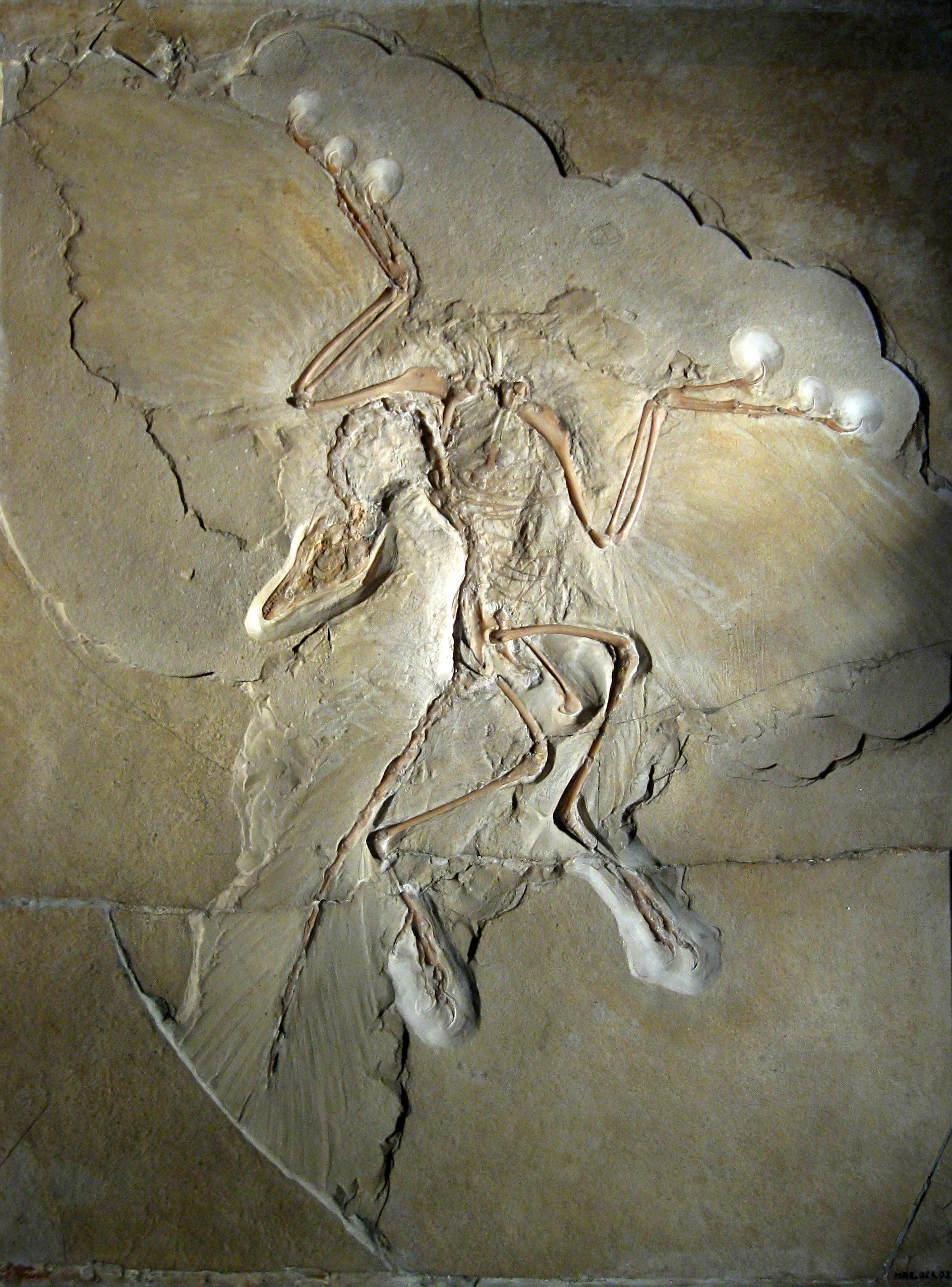
The evolutionary question had a longer and stranger history. Thomas Henry Huxley proposed the bird-dinosaur connection in 1868, barely a decade after Archaeopteryx was first described from the limestone quarries of Solnhofen, Bavaria. The creature was undeniably strange — a feathered animal with the wings of a bird but the toothed skull, clawed fingers, and long bony tail of a small theropod dinosaur. Huxley listed shared skeletal characters in detail: the structure of the foot, the form of the ankle joint, the overall proportions of the hindlimb. Birds, he argued, were essentially flying dinosaurs.
The idea did not take hold. The Danish paleontologist Gerhard Heilmann published a widely read 1926 book, The Origin of Birds, which rejected the dinosaur hypothesis on the grounds that theropods lacked clavicles — the bones from which the furcula, the wishbone, of modern birds develops. Without clavicles, there could be no evolutionary continuity. The argument was persuasive and influential, and Huxley's hypothesis retreated to the background for nearly half a century.
The turning point came from Montana. John Ostrom, a young paleontologist at Yale's Peabody Museum, recovered the bones of Deinonychus antirrhopus in 1964 — a bipedal predator with a sickle-shaped retractile claw on its second toe and a skeleton built for active, agile movement. In a 1973 paper in Nature, Ostrom laid out a systematic comparison between Archaeopteryx and small theropod dinosaurs. The clavicle problem, he argued, had been based on misidentified specimens; theropod clavicles had been recovered but overlooked. The anatomical similarities between Archaeopteryx and theropods were deep, structural, and numerous. His argument remained contested through the 1970s and 1980s, with critics proposing birds had evolved from earlier archosaurs or crocodile-line relatives.
The Chinese fossils changed the evidentiary landscape irreversibly. In August 1996, a specimen was unearthed in Liaoning Province, northeastern China, near the town of Beipiao. Ji Qiang of China's National Geological Museum noticed that the fossil was surrounded by an impression of fine filaments along the neck and back — not scales, but something more like primitive feathers. The creature, named Sinosauropteryx prima, was a small compsognathid, unambiguously a theropod dinosaur by its skeletal anatomy. Subsequent studies using scanning electron microscopy found preserved melanosomes within the filaments — the microscopic pigment-bearing organelles that give feathers their color — allowing researchers to reconstruct its coloration: reddish-brown with alternating bands along its tail.
Sinosauropteryx opened a flood. Liaoning's lake-bed sediments turned out to preserve soft tissue that ordinary stone would destroy. Protarchaeopteryx and Caudipteryx appeared in 1998, both with clearly pennaceous feathers structurally identical to those of modern birds, on animals whose skeletons made their theropod identity unmistakable. Anchiornis, described in 2009, was covered in feathers from head to toe with its plumage reconstructed in detail. Velociraptor forelimb bones revealed quill knobs — the roughened attachment points where flight feathers anchor in modern birds — meaning Velociraptor had large, structured feathers along its arms on an animal that could not fly.
By 2000, the consensus among vertebrate paleontologists was effectively unanimous: birds are theropod dinosaurs. Not the descendants of theropods — theropods themselves, a surviving lineage of the same group that produced Tyrannosaurus and Velociraptor and Allosaurus. Feathers had evolved well before flight, distributed across many theropod lineages, probably for insulation or display, and became elaborated over time. Powered flight emerged only once, in the ancestors of modern birds. The scaly dinosaur of the textbook had never been reconstructed from evidence. It was an assumption, and the assumption was wrong.