Birds and dinosaurs are completely separate groups with no close evolutionary relationship.
Birds are living dinosaurs - specifically, they are the only surviving lineage of theropod dinosaurs. Fossil feathers and skeletal similarities confirm this.
What changed?
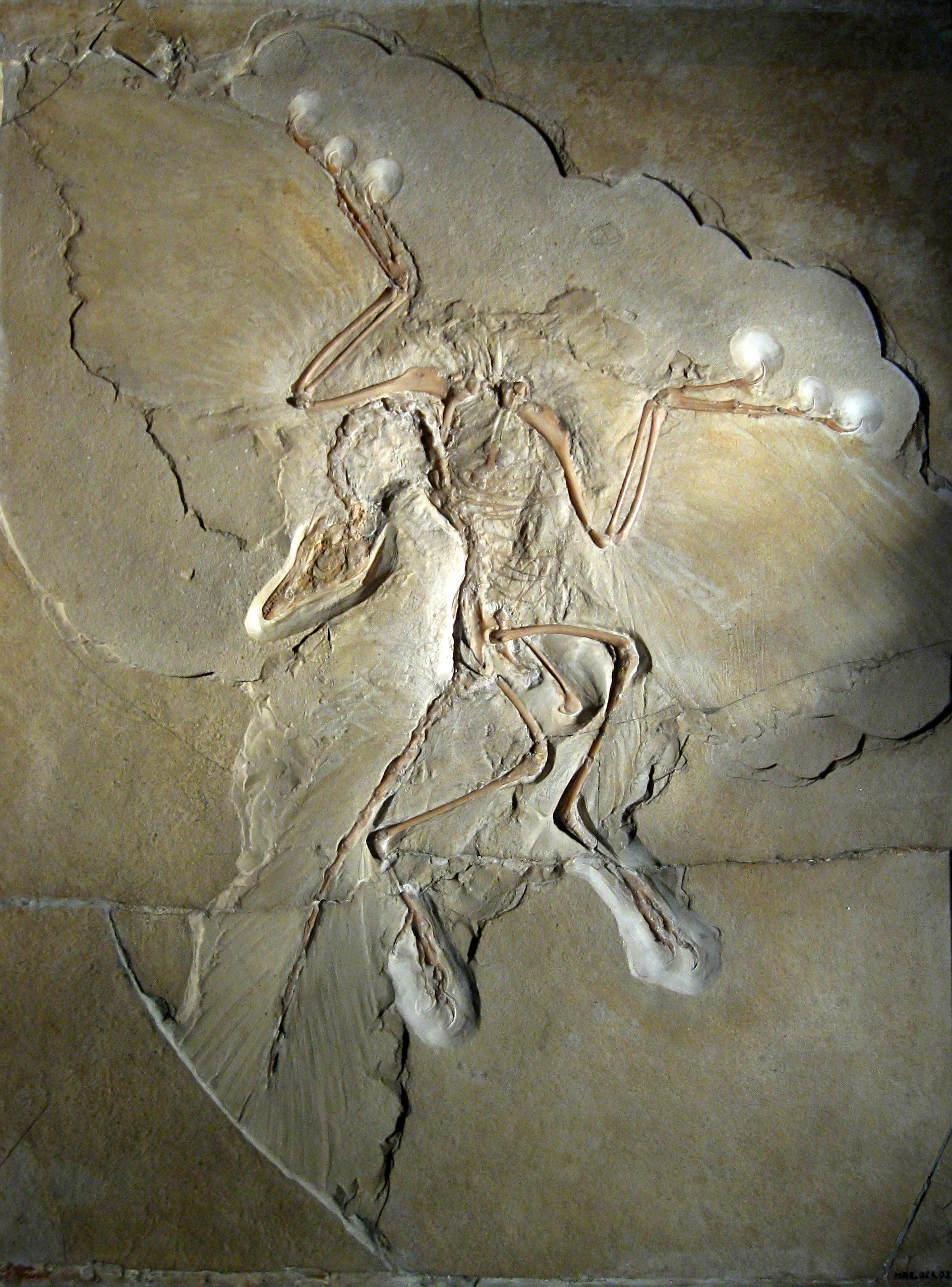
Thomas Henry Huxley proposed the connection in 1868, barely a decade after Archaeopteryx was first described from the limestone quarries of Solnhofen, Bavaria. The creature was undeniably strange, a feathered animal with the wings of a bird but the toothed skull, clawed fingers, and long bony tail of a small theropod dinosaur. Huxley, who had championed Darwin's theory of natural selection and earned the informal title of "Darwin's Bulldog," argued that the anatomical evidence pointed unmistakably toward a dinosaurian ancestry for birds. He listed the shared skeletal characters in detail: the structure of the foot, the form of the ankle joint, the overall proportions of the hindlimb. Birds, Huxley proposed, were essentially flying dinosaurs.
The idea did not take hold. Harry Seeley's 1887 reclassification of dinosaurs into two major groups complicated the picture, and the dominant alternative, that birds had descended from some earlier, generalized archosaur ancestor rather than from theropod dinosaurs specifically, gathered strength through the early twentieth century. The Danish paleontologist Gerhard Heilmann published a widely read 1926 book, The Origin of Birds, which rejected the dinosaur hypothesis on the grounds that theropods lacked clavicles, the bones from which the furcula, the wishbone, of modern birds develops. Without clavicles, there could be no evolutionary continuity. The argument was persuasive and the book was influential. Huxley's hypothesis retreated to the background for nearly half a century.
The turning point came from an unusual theropod discovered in Montana in 1964. John Ostrom, a young paleontologist at Yale's Peabody Museum, recovered the bones of what he would name Deinonychus antirrhopus, a bipedal predator with a sickle-shaped retractile claw on its second toe and a skeleton built for active, agile movement. Ostrom's 1969 monograph describing the animal was a landmark in itself, but it was his subsequent work that reshaped the question of bird origins. In a 1973 paper in Nature, Ostrom laid out a systematic comparison between Archaeopteryx and small theropod dinosaurs. The clavicle problem, he argued, had been based on misidentified specimens, theropod clavicles had been recovered but overlooked. The anatomical similarities between Archaeopteryx and theropods were not superficial; they were deep, structural, and numerous.
Ostrom's argument remained contested through the 1970s and 1980s. Critics proposed that birds had evolved from early archosaurs, from crocodile-line relatives, or from small quadrupedal tree-dwellers. The fossil record in 1985 remained incomplete enough to sustain multiple interpretations.
The Chinese fossils changed the evidentiary landscape irreversibly. Beginning in the mid-1990s, a series of extraordinary specimens emerged from the Yixian and Jiufotang Formations of Liaoning Province, lake sediments of Early Cretaceous age, roughly 130 million years old, with preservational conditions that retained feathers, soft tissues, and fine anatomical detail. In 1996, Ji Qiang of China's National Geological Museum announced Sinosauropteryx prima: a small theropod covered in filamentous feathers, unambiguously a non-avian dinosaur by its skeletal anatomy, and yet feathered. The following years brought Protarchaeopteryx, Caudipteryx, Microraptor, and dozens more, each adding detail to a picture of theropod dinosaurs adorned with feathers in various forms, arranged across a spectrum connecting the most bird-like theropods with the most dinosaur-like early birds.
By 2000, the consensus among vertebrate paleontologists was effectively unanimous: birds are theropod dinosaurs. Not the descendants of theropods, theropods themselves, a surviving lineage of the same group that produced Tyrannosaurus and Velociraptor and Allosaurus. Every sparrow is a living theropod. The categories of "birds" and "non-avian dinosaurs" are both scientifically real. What was wrong was the claimed distinctness: the idea that the two occupied entirely separate branches of the animal kingdom. The 130 or so years of classroom instruction that treated birds and dinosaurs as unrelated groups had been built on an incomplete fossil record and a faulty assumption about clavicles, both of which the twentieth century's paleontologists eventually corrected.