Dinosaurs were cold-blooded like modern reptiles.
Many dinosaurs were warm-blooded (endothermic) or had intermediate metabolisms. Evidence includes bone structure, growth rates, and the discovery of feathered dinosaurs in cold climates.
What changed?
The image was settled, or so it seemed: a massive reptile, green and scaly, dragging its tail through Mesozoic mud, torpid in the cool of morning, incapable of sustained movement. This was the dinosaur of the mid-twentieth century classroom, a biological failure, cold-blooded like its living relatives the crocodilians, alive only because it happened to be enormous. When students asked why the dinosaurs died out, the answer followed naturally from the assumption: a cold snap would have been lethal to creatures that depended entirely on external warmth.
The image had deep roots. When Richard Owen coined the name Dinosauria in 1842, he was working from the bones of Iguanodon, Megalosaurus, and Hylaeosaurus, enormous animals with superficially reptilian anatomy. The assumption that dinosaurs operated like enlarged lizards followed from the classification and was never seriously examined. By the early twentieth century, sauropods were routinely depicted wallowing in swamps because locomotion on land was assumed to require more metabolic output than a cold-blooded animal could sustain.
The challenge arrived in 1968 from Robert Bakker, a Yale undergraduate writing in Discovery, the quarterly journal of the Peabody Museum of Natural History. Bakker's argument drew on ecology rather than anatomy. Modern warm-blooded predators, lions, wolves, constitute a small fraction of their prey populations by biomass, because they require continuous food intake to maintain body temperature. Cold-blooded predators, like Komodo dragons, are proportionally more abundant in their ecosystems because their metabolic demands are far lower. Bakker calculated predator-prey ratios from dinosaur fossil assemblages and found that they matched warm-blooded ecosystems, not cold-blooded ones. Something in the standard model was wrong.
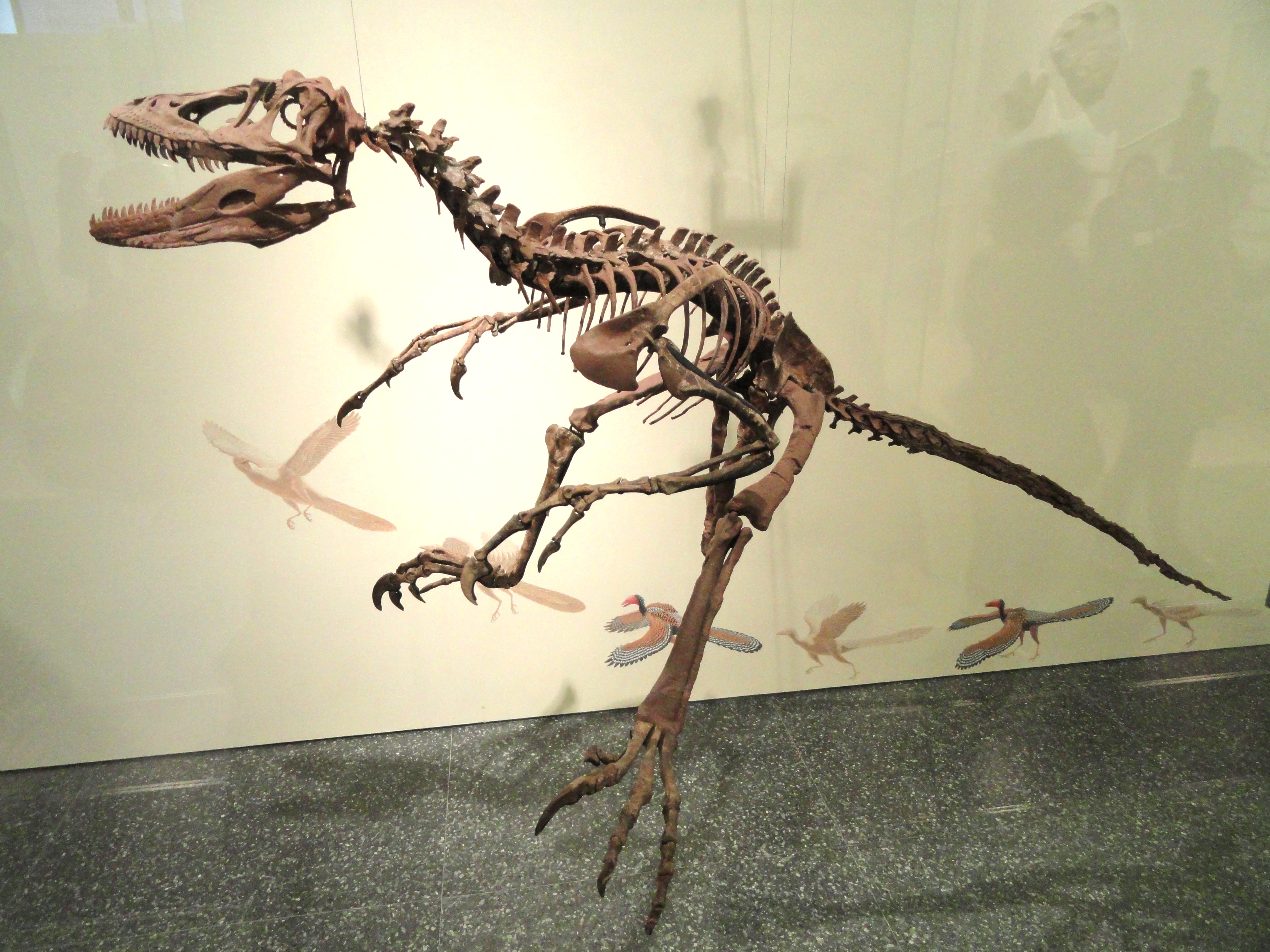
The following year, Bakker's mentor John Ostrom published his monograph on Deinonychus antirrhopus, a theropod recovered from the Cloverly Formation of Montana. The animal was built for speed and agility: long hindlimbs, a stiffened tail for balance at high velocity, a sickle-shaped second toe claw apparently designed for raking prey. Ostrom's meticulous 1969 description made the sluggish, cold-blooded interpretation of all dinosaurs nearly impossible to sustain. An animal configured like Deinonychus had to have been persistently active, and sustained activity requires internally generated heat.
Evidence from bone histology deepened the case through the 1970s and 1980s. Thin-sectioned dinosaur bones revealed dense, highly vascular tissue with growth patterns characteristic of rapid, continuous growth, the histological signature of birds and mammals, not of modern reptiles, which grow slowly and intermittently. Armand de Ricqlès, a French comparative anatomist, documented this pattern systematically across dozens of dinosaur species. The bone structure described animals that grew quickly and continuously, which is the fingerprint of an endothermic metabolism.
The discovery of feathered theropods in China's Liaoning Province beginning in 1996 added a biogeographic dimension. Small feathered dinosaurs were recovered from sediments deposited in cool, temperate lake environments. Feathers function as insulation; an animal without internal heat to retain has no use for insulating structures. Their presence in non-tropical climates, in species clearly too small to achieve stable temperatures through body mass alone, implied active temperature regulation.
The picture that emerged by the early twenty-first century was genuinely complex. Large sauropods may have achieved stable body temperatures through bulk alone, inertial homeothermy, without the full metabolic machinery of true endothermy. Small theropods appear to have been warm-blooded in essentially the bird sense. Oxygen isotope analysis of fossilized bone and tooth enamel, which reconstructs body temperature from the thermodynamic signatures of mineral formation, produced results consistent with internal heat generation across multiple dinosaur lineages.
The cold-blooded model persisted in textbooks for decades after Bakker's 1968 challenge, sustained by institutional inertia and the time required to synthesize evidence from ecology, histology, biomechanics, and geochemistry into a coherent picture. By the time Jurassic Park's actively warm-blooded theropods reached movie theaters in 1993, the scientific community had largely abandoned the cold-blooded framework, but many educators who had learned it in the 1950s and 1960s were still teaching it.