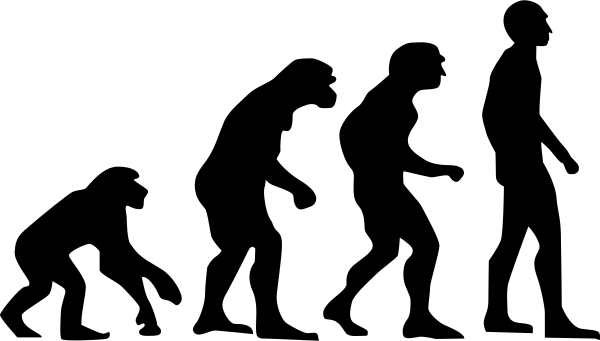
Human evolution is a linear ladder: monkey → ape → primitive human → modern human.
Evolution is a branching bush, not a ladder. Humans and modern apes share a common ancestor; we did not evolve from any modern ape species.
What changed?
In 1965, a fold-out illustration appeared in Early Man, a volume in the Time-Life Nature Library produced for general audiences and widely adopted in school libraries. The image, painted by Rudolph Zallinger, showed fifteen figures arranged from left to right: a small, stooped, apelike creature at the far left progressing through increasingly upright, hairless, tool-equipped forms until a fully modern Homo sapiens stood at the right edge, erect and confident, having arrived. The illustration was titled "The Road to Homo Sapiens." The world came to know it as the March of Progress.
Zallinger himself was uneasy. He had attempted to arrange the figures in a branching layout that would suggest divergence rather than sequence, but the paleoanthropologist Elwyn Simons insisted on the linear arrangement. The resulting image looked like a directed march toward a predetermined destination, modern humanity, rather than a messy evolutionary history with many dead ends. Within a decade it had become arguably the most reproduced scientific illustration in history, appearing in textbooks, magazine covers, advertisements, and political cartoons so frequently that it functioned not merely as a depiction of evolution but as the default mental image of what evolution was.
The image was wrong in nearly every particular. The fifteen figures are not ancestral to one another in sequence: several are cousins, collateral relatives that lived simultaneously and shared a common ancestor without one giving rise to the next. Neanderthals, depicted near the right end of the line, were not evolutionary predecessors to modern humans but a separate lineage that diverged from our common ancestor perhaps 500,000 years ago and coexisted with Homo sapiens in Europe before going extinct. Homo erectus, depicted midway along, lived in Asia and Africa for nearly two million years while other hominins were also present, and did not simply transform into more modern forms in a sequential relay.
Stephen Jay Gould, a Harvard paleontologist, devoted considerable energy throughout the 1970s and 1980s to dismantling what he called the iconography of the ladder. His 1989 book Wonderful Life argued that life is not a predictable progression toward more complex or more intelligent forms but "a copiously branching bush, continually pruned by the grim reaper of extinction." The bush metaphor was not Gould's alone: paleoanthropologist Milford Wolpoff and colleagues had been arguing since the 1970s that the hominin fossil record, when read carefully, showed not a linear sequence but an overlapping tangle of species with complex geographic and temporal distributions.
The accumulation of fossil evidence over the following decades made the bush model inescapable. Discoveries of Homo floresiensis in Indonesia in 2003, Homo naledi in South Africa in 2013, and Denisovans in Siberia (known first from DNA before any substantial skeletal material was found) demonstrated that the genus Homo was, for most of its history, home to multiple coexisting species. Ancient DNA analysis confirmed that modern humans interbred with Neanderthals and Denisovans, producing living humans who carry measurable percentages of both lineages' genomes. There was no march. There was an ecological radiation, a series of extinctions, and an ultimately arbitrary survival, not the triumphant terminus of a directed journey but one surviving twig of a once-bushy tree.