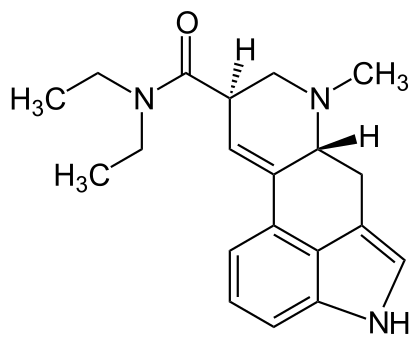
LSD and similar psychedelics have no long-term effects and may have legitimate therapeutic or mind-expanding applications.
LSD can trigger persistent psychotic episodes in vulnerable individuals and cause HPPD (hallucinogen persisting perception disorder). While some therapeutic research was legitimate, the risks were poorly understood and seriously underplayed in early 1960s research.
What changed?
In the spring of 1960, Timothy Leary administered psilocybin mushrooms for the first time and emerged convinced that the experience had changed him more than all his years of academic psychology. He was a lecturer at Harvard, the author of a personality assessment instrument used in clinical settings, a man with credentials. His conversion to psychedelic advocacy came not from fringe culture but from within American research psychology, and it gave the drug a respectability that proved difficult to dislodge.
The therapeutic research was real before it was notorious. Throughout the 1950s, Humphry Osmond in Saskatchewan was administering LSD to alcoholics and reporting significant rates of abstinence. Sidney Cohen at the Veterans Administration Hospital in Los Angeles conducted a careful survey of adverse effects from LSD use in 1960, examining twenty-five thousand administrations across nearly five thousand subjects and concluding that serious complications were rare in controlled clinical settings. Scientific American had covered the research. The impression that psychedelics were powerful but manageable, capable of producing lasting benefit if properly used, was formed partly from legitimate empirical work and partly from the enthusiasm of its interpreters.
Leary and Richard Alpert, his colleague in Harvard's Department of Social Relations, administered psilocybin to prisoners at Concord State Penitentiary beginning in 1961 and reported dramatic reductions in recidivism. The Harvard Psilocybin Project distributed psychedelics to clergy, to artists, to philosophers, tracking their reports. The research methods would not survive modern peer review,the controls were weak, the measurement inconsistent,but in their moment they generated genuine academic interest in drugs that seemed to offer something new.
What neither Leary nor Cohen's survey could adequately capture was the effect of psychedelics outside clinical settings, administered to people who had not been screened for psychiatric vulnerability, without professional guidance, in doses and contexts that varied enormously. As LSD spread through countercultural networks after 1963,Leary had been dismissed from Harvard but continued his advocacy publicly,the population using it expanded far beyond the volunteers in supervised studies. Reports of adverse outcomes accumulated in hospital emergency rooms. Psychiatrists began documenting cases of prolonged psychotic episodes triggered by LSD use, sometimes in people with no prior psychiatric history. The phenomenon of flashbacks,spontaneous recurrences of perceptual disturbance weeks or months after drug use,was described in the clinical literature beginning in 1967.
The condition that psychiatry later codified as hallucinogen persisting perception disorder, or HPPD, involves visual disturbances,trailing afterimages, geometric patterns, flickering in peripheral vision,that persist long after the drug has cleared the system. HPPD in its more severe form, in which these disturbances are continuous and functionally debilitating, is rare, but it exists. Its existence was invisible to early researchers because they were studying screened volunteers in controlled settings, not the broader population of unsupervised users.
Congress placed LSD on Schedule I under the Controlled Substances Act in 1970, citing high abuse potential and no accepted medical use. The research community, which had believed it was building toward clinical applications, was largely shut out. LSD trials did not resume in the United States until the 1990s, when the evidence base had changed substantially. By then, the scientific understanding had shifted from the early therapeutic optimism to a more complicated picture: psychedelics could produce genuine perceptual and psychological alterations that lasted beyond the drug's clearance from the body, particularly in vulnerable individuals, and the conditions that made the therapeutic research of the 1950s look safe,careful screening, controlled dosing, professional presence,were exactly the conditions that mass recreational use consistently lacked.