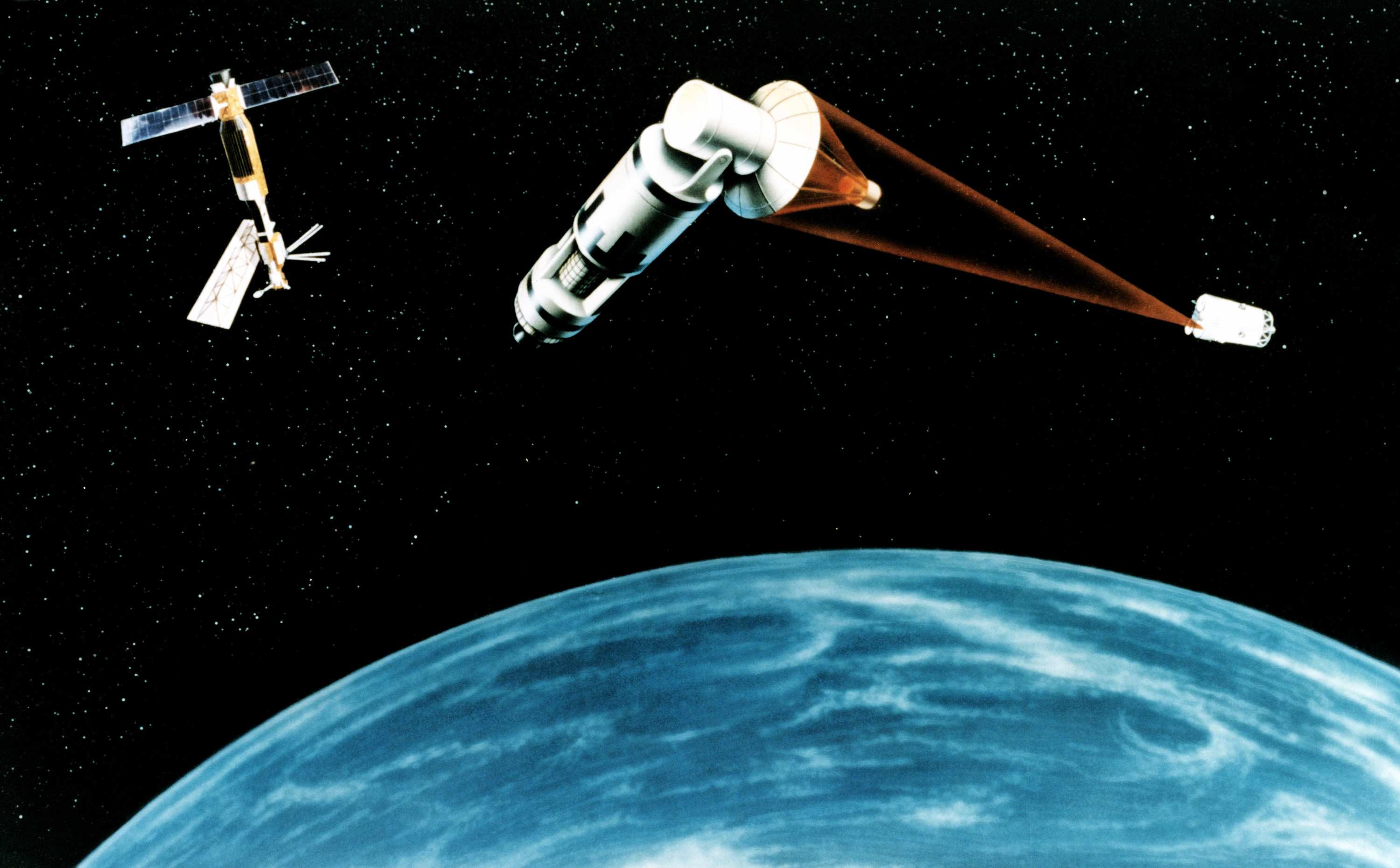
President Reagan's 1983 announcement of the Strategic Defense Initiative arrived in American classrooms as established fact before scientists had evaluated whether the physics would cooperate. Civics textbooks in the mid-1980s presented SDI as the next great leap in American technological achievement, a program that would harness lasers and particle beams to create an impenetrable shield against nuclear attack. Students read that space-based weapons platforms, guided by networks of satellites and supercomputers, would track and destroy Soviet missiles during their vulnerable boost phase, rendering the doctrine of mutual assured destruction obsolete. The Strategic Defense Initiative Organization, established in 1984 with billions in congressional appropriations and thousands of researchers across national laboratories and defense contractors, lent the vision institutional weight. This was not speculative fiction. This was policy.
The premise had a certain Cold War logic. If the Manhattan Project could build an atomic bomb in under three years, and if NASA could land men on the Moon within a decade of Kennedy's challenge, then American ingenuity could surely solve the missile defense problem given sufficient resources and resolve. Reagan himself believed deeply in the vision, describing MAD as a suicide pact that offended both strategic sense and moral decency. The program's scale and official backing suggested the technology was either ready or soon would be. What students typically did not learn was that the scientific community considered the proposal somewhere between wildly premature and physically impossible.
In April 1987, the American Physical Society released the conclusions of a two-year study examining whether SDI's core technologies could work. The APS assembled specialists in laser physics, materials science, computer engineering, and related fields to evaluate the program's technical claims. Their conclusion was unequivocal: the technologies required for a space-based missile defense system did not exist, were nowhere near existing, and would need at least another decade of fundamental research before scientists could even determine if such a system was theoretically achievable. The obstacles were not engineering challenges waiting for better funding. They were problems rooted in basic physics.
Directed-energy weapons capable of destroying missiles hundreds of miles away during a boost phase lasting only minutes would require power sources that did not exist and could not fit on any orbiting platform then conceivable. The mirrors needed to focus laser beams across such distances would have to be orders of magnitude larger and more precise than any optics ever deployed in space. The computational challenge was equally daunting. The system would need to detect launches, calculate trajectories, distinguish actual warheads from decoys, prioritize targets, and execute intercepts within windows measured in seconds, all while operating autonomously because ground-based control would introduce fatal delays. The computers of the 1980s, even the most advanced supercomputers available, could not perform these tasks within the required timeframes. The decoy problem alone appeared unsolvable with any foreseeable sensor technology.
What made the APS report particularly damaging was that it did not attack the program on political or strategic grounds. The scientists assumed, for purposes of analysis, that SDI was desirable policy. They simply evaluated whether it was possible. The answer was no, or at least not within any relevant planning horizon.
The program's diplomatic function, meanwhile, was proving entirely real. At the October 1986 Reykjavik summit, Reagan and Gorbachev nearly agreed to eliminate all ballistic nuclear weapons, a disarmament breakthrough that would have reshaped global security. The talks collapsed because Reagan refused to confine SDI research to laboratories, and Gorbachev would not accept a future where American missile defenses could neutralize Soviet deterrence. The strategic balance that had prevented superpower war for four decades depended on both sides remaining vulnerable. A working missile defense would destroy that equilibrium, assuming the defense actually worked. SDI functioned as a bargaining chip whether or not the technology would ever materialize.
After the APS report, congressional enthusiasm cooled and budgets shrank. The program refocused on less ambitious goals, was renamed, and eventually redirected toward theater missile defenses in 1993. Subsequent decades have produced systems capable of intercepting single missiles under controlled test conditions. A comprehensive defense against a sophisticated nuclear arsenal remains beyond reach. The vision Reagan described in 1983 inspired a generation. The physics remains, as it was then, uncooperative.