In February 1976, soldiers at Fort Dix, New Jersey, began falling ill with a respiratory illness that would reshape American public health for decades. One soldier, Private David Lewis, died. Virologists who analyzed the samples identified an influenza strain with disturbing characteristics: it was antigenically related to the virus that had caused the 1918 pandemic, the worst infectious disease event of the twentieth century, which had killed an estimated 50 to 100 million people worldwide. The new strain was classified as A/New Jersey/1976/H1N1, quickly nicknamed swine flu.
The federal response was swift and enormous. President Gerald Ford convened a meeting of public health officials, including Jonas Salk and Albert Sabin, the creators of the polio vaccines, and asked whether the government should act. The answer was yes. In late March, Ford announced a plan to vaccinate every American, all 220 million of them, before the following flu season. Congress allocated $135 million. The National Influenza Immunization Program was born.
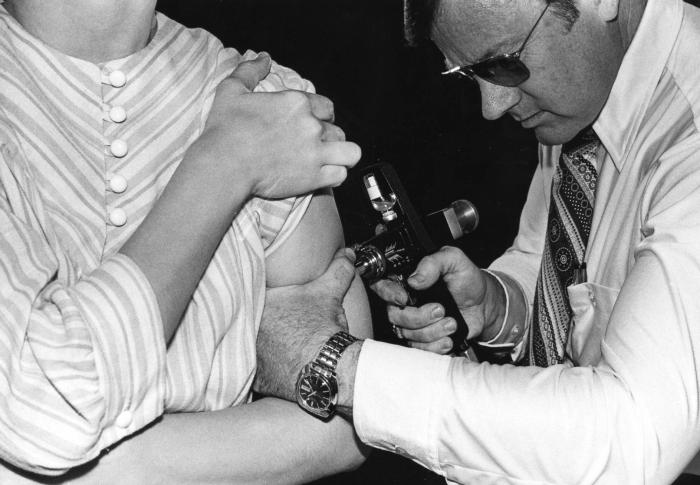
To encourage uptake, Ford was vaccinated on live national television on October 14, 1976, at a clinic in Washington. Other administration officials followed. The message was unmistakable: this was a necessary medical intervention, endorsed at the highest levels, and it was safe. Public health officials expressed confidence. The vaccine had been tested. The program was proceeding exactly as planned.
By December, approximately 45 million Americans had received the shot. Then the reports started.
Neurologists began noticing an unusual cluster of Guillain-Barré syndrome cases among recently vaccinated patients. Guillain-Barré is a rare autoimmune condition in which the immune system attacks the peripheral nervous system, causing weakness and sometimes paralysis. The syndrome can be triggered by infections and, occasionally, by vaccines. By mid-December, the accumulating case reports had attracted enough attention that the Center for Disease Control initiated a nationwide surveillance effort. The program was suspended December 16, 1976, ten weeks after Ford's televised injection.
Epidemiologist Lawrence Schonberger and colleagues subsequently analyzed the surveillance data and published their findings in the American Journal of Epidemiology in 1979. The study identified 1,098 Guillain-Barré patients with onset between October 1, 1976, and January 31, 1977. Among vaccinated adults, the attributable risk was just under one case per 100,000 vaccinations, a small number in absolute terms, but statistically robust and significantly elevated compared to the unvaccinated population. Approximately 450 excess Guillain-Barré cases were attributed to the vaccine.
The pandemic that justified all of this never came. After the initial Fort Dix outbreak, swine flu spread no further. No epidemic materialized in the United States. No wave swept Europe. Whatever the virus was capable of, it did not achieve sustained human-to-human transmission. The 45 million Americans who had been vaccinated against a pandemic that did not arrive were left with a preventive intervention that, for a small number of them, had caused a serious neurological illness.
The 1976 episode became one of the most studied events in public health history, a case study in the difficulty of making rapid decisions under conditions of genuine uncertainty. Public health authorities in 1976 were not wrong to take the Fort Dix finding seriously; a reassortment of influenza genes resembling the 1918 strain was not something any responsible official could have ignored. What the episode revealed was that the infrastructure for communicating uncertainty, for telling the public what was known and what was not, was underdeveloped. Ford's televised vaccination conveyed certainty. When that certainty turned out to be partial, the damage to institutional trust proved lasting.