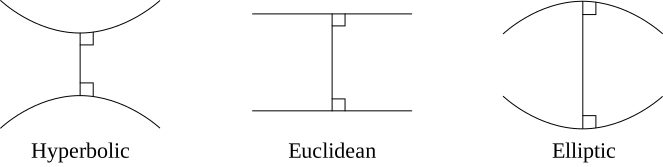
Now we know:
The 180-degree rule holds only in flat Euclidean space. On the surface of a sphere, a triangle with one vertex at the North Pole and two vertices on the equator 90 degrees apart has three right angles, summing to 270 degrees. Einstein's general relativity confirmed that physical space near massive objects is geometrically curved, and light-ray triangles near massive stars do not obey the Euclidean rule.
Euclid's fifth postulate, the one about parallel lines, had troubled mathematicians since antiquity. The other four postulates were economical: a line segment can be extended, a circle can be drawn with any center and radius, all right angles are equal to each other. The fifth postulate required considerably more words: if a straight line crosses two other straight lines and creates interior angles on one side summing to less than two right angles, those two lines will eventually meet on that side if extended far enough. It was workable but inelegant, and for two thousand years mathematicians tried to prove it from the other four and failed.
The failure was not a deficiency in their methods. It was a signal about the nature of geometry itself. Janos Bolyai and Nikolai Lobachevsky, working independently around 1830, produced the first non-Euclidean geometries by replacing the parallel postulate with a different assumption. On a surface where lines diverge, triangle angles sum to less than 180 degrees. On a surface where lines converge, they sum to more. Bolyai wrote to his father Farkas, himself a mathematician, that he had created 'a new and different world out of nothing.' Carl Friedrich Gauss, reading their papers, disclosed that he had been privately developing similar ideas for decades but had not published, fearing the reaction.
The most vivid physical realization of non-Euclidean geometry sits on a globe. Draw a triangle with one vertex at the North Pole and two vertices on the equator, separated by 90 degrees of longitude. Each of the three interior angles is a right angle. The angles sum to 270 degrees. The sides are great circle arcs, the shortest possible paths on the sphere's surface, and the triangle violates the 180-degree rule without any geometric inconsistency.
This geometric reality was treated as a mathematical curiosity with no physical implications until Albert Einstein's general theory of relativity, completed in 1915, made it consequential. General relativity describes gravity as a curvature of spacetime rather than a force. Near a massive object, space itself is geometrically curved, and triangles formed by light rays do not have angles summing to 180 degrees. Arthur Eddington's 1919 eclipse observations confirmed this: starlight bent around the sun by exactly the amount general relativity predicted, not by the smaller amount Newtonian mechanics allowed. The result was direct experimental confirmation that physical space is not Euclidean.
The practical consequence most familiar to the late 20th century came from the Global Positioning System. GPS satellites orbit at altitudes where both gravitational and velocity-induced time dilation effects, predicted by relativity, would cause position errors accumulating to several kilometers per day if left uncorrected. The corrections built into GPS calculations require treating spacetime as a curved, non-Euclidean geometry.
Geometry classrooms through much of the 20th century taught that triangle angles sum to 180 degrees as a universal fact, without the qualifier that the statement holds only in flat Euclidean space. The Euclidean system is consistent and internally complete; the 180-degree rule is true within it by derivation from the axioms. The difficulty was the absence of any distinction between the mathematical system and a description of physical reality, a distinction the curriculum rarely made.