Disproven Facts
Physics

Atoms look like tiny solar systems, with electrons orbiting the nucleus in fixed circular paths.

Now we know:

Electrons occupy probabilistic orbitals, not fixed circular paths. The quantum mechanical model had superseded the Bohr model by the late 1920s but textbook diagrams lagged far behind.

Disproven 1926

What changed?

Niels Bohr proposed his atomic model in 1913 and it was an immediate triumph. Before Bohr, physicists knew atoms had a dense positive nucleus (Rutherford had established that in 1911) and electrons somewhere around it, but had no explanation for why electrons didn't simply spiral into the nucleus, radiating energy as they went. Bohr solved it with a bold postulate: electrons can only occupy certain fixed orbits, and they don't radiate energy while staying in one. The model predicted hydrogen's spectral lines with stunning precision. The solar system analogy was irresistible, a central nucleus like the Sun, electrons wheeling around it like planets, and the image stuck.

The problem arrived quickly. The Bohr model worked beautifully for hydrogen, with one electron. For atoms with more than one electron, it failed. More fundamentally, it offered no explanation for why only certain orbits were allowed. Bohr had imposed the rule without deriving it.

The explanation came in the mid-1920s in a rush of new physics. Louis de Broglie proposed in 1924 that electrons have wave properties. Werner Heisenberg formulated his uncertainty principle in 1927: the more precisely you know an electron's position, the less precisely you can know its momentum, and vice versa. You cannot, even in principle, specify a fixed circular path. Erwin Schrödinger's wave equation, published in 1926, replaced the tidy orbits with probability distributions, mathematical regions of space where an electron is likely to be found. These regions are called orbitals, not orbits, and they look nothing like planetary paths. Some are spherical, some are dumbbell-shaped, some have complex lobed geometries.

The quantum mechanical model of the atom became the established framework of physics and chemistry by the late 1920s. Yet the solar system diagram, neat circles around a dotted nucleus, continued appearing in American science textbooks through the 1970s and, in some cases, well beyond. It persists today in logos, icons, and popular imagery. It's wrong as a literal description of atomic structure, but it retains a powerful hold because it's the only atomic image simple enough to draw.

What electrons actually do is stranger than orbits. Each electron occupies a standing wave pattern that envelops the entire nucleus. It doesn't travel a path; it exists as a smeared probability until measured. The Bohr model was a crucial step, a bridge between classical physics and quantum mechanics, but the bridge is not the destination.
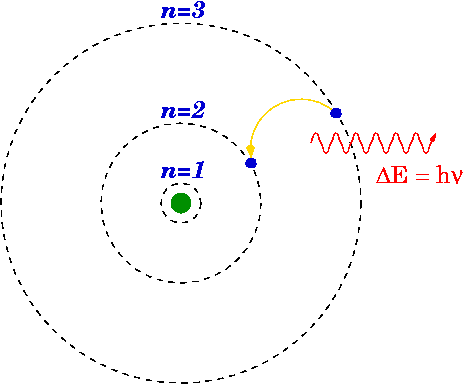
Diagram of the Bohr atomic model showing concentric circular orbits around a central nucleus, with electrons depicted as coloured dots in fixed paths.
The Bohr model of the atom (1913): electrons in fixed circular orbits around the nucleus, colour-coded by energy level. This diagram still dominates popular depictions of atoms despite being superseded by quantum mechanics in the 1920s. · Brighterorange - CC BY-SA 3.0
Grid of cross-section images showing the probability density distributions of hydrogen atom electron orbitals in various quantum states, ranging from spherical to complex multi-lobed shapes.
Probability density plots of hydrogen electron orbitals from quantum mechanics. Unlike the Bohr model's tidy circles, real electrons occupy diffuse, three-dimensional probability clouds. · PoorLeno - Public Domain

At a glance

Disproven
1926
Believed since
1913
Duration
13 years
Taught in schools
1945 – 1926

Sources

  1. [1] Über den anschaulichen Inhalt der quantentheoretischen Kinematik und Mechanik (Uncertainty Principle) - Heisenberg, W., 1927

See also

Physics
You were taught:

There are three states of matter: solid, liquid, and gas.

Now we know:

There are at least four fundamental states (solid, liquid, gas, plasma), plus many others like Bose-Einstein condensates, superfluids, and more.

Disproven1924
Read more →
Math
You were taught:

You cannot take the square root of a negative number. It is undefined and mathematically impossible.

Now we know:

The square root of negative one, written as i, defines the imaginary unit and extends the real numbers to the complex number system. Complex numbers are physically real in the deepest sense: quantum mechanics cannot be expressed using only real numbers, and electrical engineering, signal processing, and GPS calculations all rely on complex arithmetic.

Disproven1799
Read more →
Physics
You were taught:

Light and electromagnetic waves travel through a medium called the 'luminiferous aether' that fills all space.

Now we know:

Light does not require a medium. Einstein's special relativity (1905) and the Michelson-Morley experiment (1887) disproved the aether.

Disproven1905
Read more →
Math
You were taught:

The angles in any triangle always add up to exactly 180 degrees.

Now we know:

The 180-degree rule holds only in flat Euclidean space. On the surface of a sphere, a triangle with one vertex at the North Pole and two vertices on the equator 90 degrees apart has three right angles, summing to 270 degrees. Einstein's general relativity confirmed that physical space near massive objects is geometrically curved, and light-ray triangles near massive stars do not obey the Euclidean rule.

Disproven1919
Read more →