Disproven Facts
Physics

Centrifugal force is a real outward force that pushes objects away from the center of rotation.

Now we know:

Centrifugal force is a fictitious (inertial) force - it only appears in rotating reference frames. The real force is centripetal, pulling inward.

Disproven 1920

What changed?

The feeling is unmistakable. You're in a car rounding a curve and you feel pushed hard against the door. A bucket of water swung on a rope holds its contents against the bottom, as if some force is pinning the water down. A clothes dryer pushes laundry against the drum wall. Something is clearly acting outward. We call it centrifugal force, and it seems as real as any force you've ever felt.

Newton would disagree. In his framework, the framework of all classical mechanics, forces have sources. Gravity comes from mass, electromagnetic force from charge, friction from contact. Centrifugal force has no source. In an inertial (non-accelerating) reference frame, there is no outward force on the car passenger. What there is, instead, is a car door pressing inward, providing the centripetal force that keeps you turning with the car. Your body wants to continue in a straight line, that's inertia, and the door won't let it. You feel the door push you; you interpret it as being pushed outward.

The distinction matters because it depends entirely on where you're doing your physics. In an inertial reference frame, one that isn't accelerating or rotating, centrifugal force does not appear. The only real force is the centripetal one, always pointing toward the centre of the circular path. For a planet orbiting a star, that's gravity. For a ball on a string, it's tension. For a car turning, it's friction between the tyres and the road.

In a rotating reference frame, say, you're sitting inside the rotating drum of a centrifuge, trying to do physics as if you were stationary, centrifugal force does appear, as a mathematical term that must be added to Newton's equations to make them work in that frame. Physicists call this a "fictitious force" or "pseudo-force": not something that acts on objects from outside, but a correction term that accounts for the fact that your reference frame is accelerating. The Coriolis force, responsible for the rotation of hurricanes, is another fictitious force in the same sense.

Engineers routinely use centrifugal force as a working concept and it produces perfectly correct results in rotating frames. The confusion arises when it's presented as a real physical force in the same category as gravity or friction, rather than as a frame-dependent mathematical convenience. You are never actually pushed outward. You are simply allowed, or not allowed, to continue in a straight line.
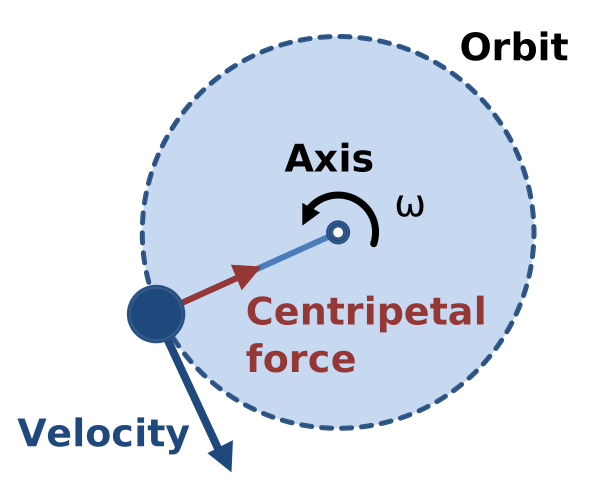
Diagram illustrating a ball in circular motion, showing the velocity vector tangential to the path and the centripetal acceleration pointing toward the centre.
In circular motion, centripetal force (pointing inward) keeps an object on its curved path. In a rotating reference frame, an observer experiences an apparent outward centrifugal force - a fictitious force that is nonetheless real and measurable within that frame. · Htkym - CC BY-SA 3.0

At a glance

Disproven
1920
Believed since
1700
Duration
220 years
Taught in schools
1945 – 1920

Sources

  1. [1] Philosophiæ Naturalis Principia Mathematica - Newton, I., 1687
  2. [2] Classical Mechanics (3rd ed.) - Goldstein, H., Poole, C., and Safko, J., 2002

See also

Technology
You were taught:

The internet is essentially anonymous. Online activity cannot be traced or used against you.

Now we know:

Internet activity leaves extensive digital traces - IP addresses, browser fingerprints, cookies, ISP logs, and server logs. This was true from the internet's inception. The expectation of anonymity was always a misconception.

Disproven2000
Read more →
Math
You were taught:

The angles in any triangle always add up to exactly 180 degrees.

Now we know:

The 180-degree rule holds only in flat Euclidean space. On the surface of a sphere, a triangle with one vertex at the North Pole and two vertices on the equator 90 degrees apart has three right angles, summing to 270 degrees. Einstein's general relativity confirmed that physical space near massive objects is geometrically curved, and light-ray triangles near massive stars do not obey the Euclidean rule.

Disproven1919
Read more →
Biology
You were taught:

Human races are distinct biological categories with innate differences in intelligence and ability.

Now we know:

Race is primarily a social construct. Genetic variation within populations far exceeds variation between them — approximately 85% of all human genetic variation occurs within conventionally defined racial groups, not between them. There is no scientific basis for racial hierarchy in cognition or ability. Group IQ score gaps are fully explained by socioeconomic factors, educational access, test design, stereotype threat, and the Flynn effect — not genetics. The APA's 1996 task force found no evidence for genetic explanations of group differences.

Disproven1996
Read more →
Geology
You were taught:

The continents are fixed in place and have always occupied their current positions.

Now we know:

Plate tectonics, established as scientific consensus by 1966-1968, shows that continents ride on rigid plates driven by mantle convection. Seafloor spreading at mid-ocean ridges creates new crust and pushes plates outward at roughly the rate a fingernail grows. Wegener's core insight was right; the mechanism came from the ocean floor, not from him.

Disproven1966
Read more →