Disproven Facts
Astronomy

Space is completely empty between planets and stars.

Now we know:

Space contains plasma, gas, dust, cosmic rays, magnetic fields, and electromagnetic radiation. Luna 1 (1959) directly measured the solar wind - a continuous stream of charged particles from the sun.

Disproven 1959

What changed?

The idea that space was simply "nothing", a perfect void between the planets, seemed like common sense. Stars were separated by vacuum, and vacuum meant empty: no air, no matter, no substance. Even physicists in the early 20th century, after abandoning the luminiferous aether, tended to treat interplanetary space as essentially featureless. School curricula through the 1950s reinforced the picture: space was a void through which planets and comets moved, with nothing in between.

Luna 1 ended that comfortably simple picture on January 2, 1959.

The Soviet spacecraft, the first human-made object to escape Earth’s gravity and enter heliocentric orbit, carried a magnetometer and ion traps designed to probe the environment near the Moon. It didn’t find much of a lunar magnetic field. But physicist Konstantin Gringauz, analysing the ion trap data, recorded something unexpected: a continuous stream of charged particles flowing outward from the Sun at hundreds of kilometres per second. The solar wind was real, and interplanetary space was full of it.

The solar wind, a constant outflow of electrons, protons, and heavier ions from the Sun’s corona, travels between 400 and 800 kilometres per second and extends to the edge of the heliosphere, roughly 100 astronomical units from the Sun. It is far from the only thing filling what we call “empty” space. The interplanetary medium also contains cosmic dust, magnetic field lines dragged from the Sun, energetic particles from across the galaxy, and, in denser regions, vast molecular clouds at temperatures barely above absolute zero.

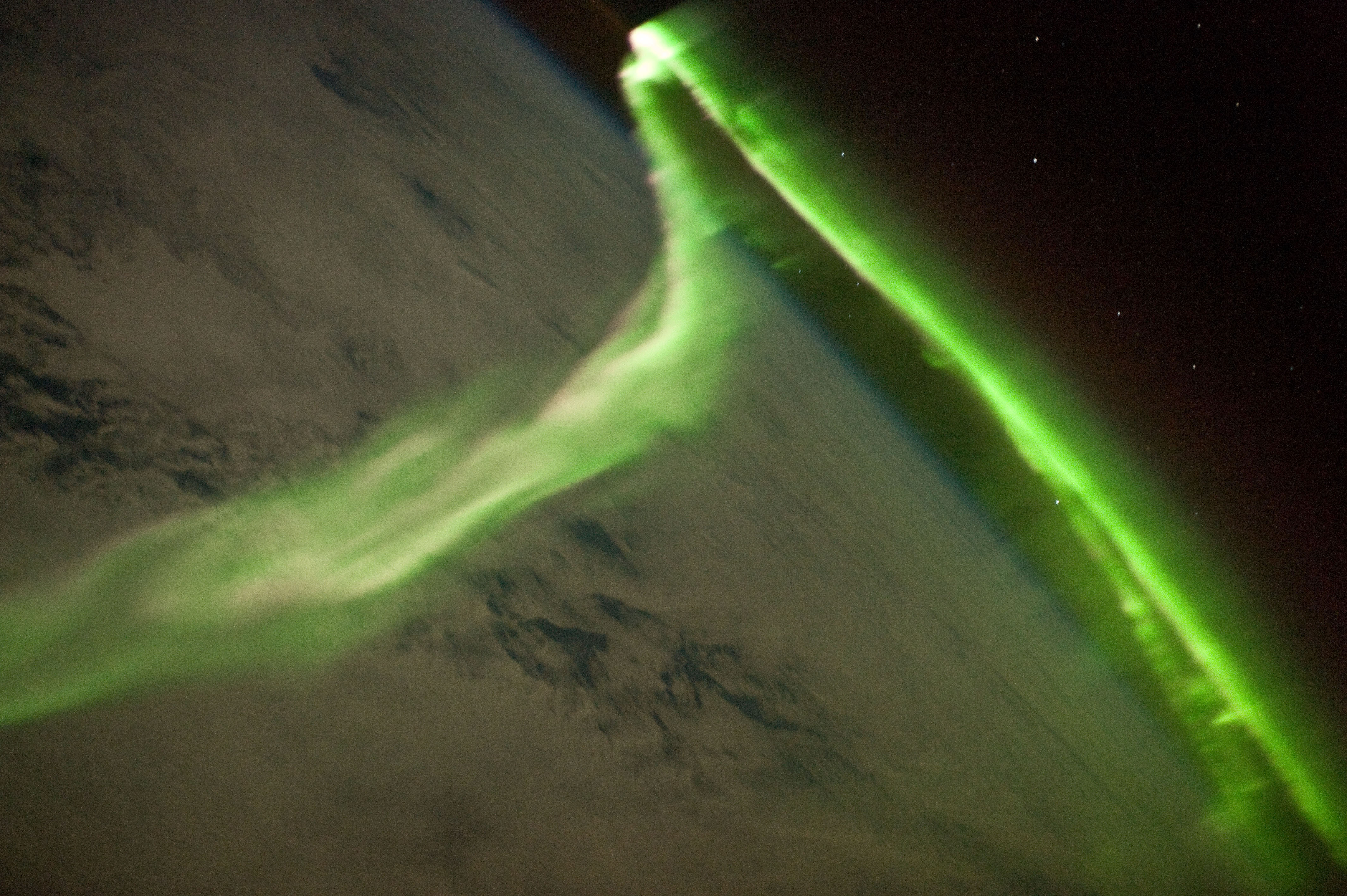
The practical consequences became clear in subsequent decades. The solar wind sculpts planetary magnetospheres, strips atmospheres from planets without magnetic protection (as it did to Mars), and drives the aurora borealis and aurora australis visible at Earth’s poles. Space had never been empty. It had simply been waiting for instruments sensitive enough to read it.

A replica of the Luna 1 spacecraft - a small spherical probe with antennae extending outward - on display at a museum.
Luna 1, the Soviet spacecraft that became the first human-made object to escape Earth's gravity and directly measure the solar wind in January 1959. · RIA Novosti - CC BY-SA 3.0
A glowing green aurora australis curving across the night side of Earth as seen from the International Space Station.
Aurora Australis photographed from the International Space Station - a direct visible consequence of the solar wind interacting with Earth’s magnetic field. · NASA - Public Domain

At a glance

Disproven
1959
Believed since
1930
Duration
29 years
Taught in schools
1945 – 1959

Sources

  1. [1] Luna 1 — NASA Space Science Data Center - NASA, 2024
  2. [2] The Multi-Scale Nature of the Solar Wind - Verscharen, D. et al., 2019

See also

Astronomy
You were taught:

Space travel to the Moon was primarily an engineering challenge; radiation in space was not a serious biological hazard for short missions.

Now we know:

The Van Allen radiation belts and solar particle events posed genuine radiation hazards. Apollo trajectories were specifically designed to minimize belt transit time, and NASA tracked radiation doses carefully. A major solar particle event during a lunar transit could have been fatal; astronauts were fortunate none occurred. Post-mission analyses showed some Apollo astronauts received doses approaching occupational safety limits.

Disproven1970
Read more →
Physics
You were taught:

There are three states of matter: solid, liquid, and gas.

Now we know:

There are at least four fundamental states (solid, liquid, gas, plasma), plus many others like Bose-Einstein condensates, superfluids, and more.

Disproven1924
Read more →
Astronomy
You were taught:

The Moon is a barren, geologically dead rock with no resources or scientific interest beyond astronomy.

Now we know:

The Moon has significant scientific interest: it records early solar system history, contains water ice in permanently shadowed craters, has Helium-3 deposits, and its regolith chemistry reveals much about planetary formation. Apollo 8 (December 1968) brought humanity's first direct view of lunar surface from orbit.

Disproven1969
Read more →
Physics
You were taught:

Light and electromagnetic waves travel through a medium called the 'luminiferous aether' that fills all space.

Now we know:

Light does not require a medium. Einstein's special relativity (1905) and the Michelson-Morley experiment (1887) disproved the aether.

Disproven1905
Read more →